The purpose of this blog is to introduce the Museum of Russian Poetry and Music to the wide American audience and attract like-minded enthusiasts who wish to promote Russian culture in the US. Read more.

Monday, August 20, 2012

17th annual Tsvetaeva Bonfire

This year museum celebrates: 
 120th Birthday of Russian Poet Marina Tsvetaeva
                15 years of “Washington Museum of Russian Poetry and Music” 
Everybody is invited to the 17th annual Tsvetaeva Bonfire!
It will take place on Sunday, October 7rd, 2012, at 2:00 P.M., at Rock Creek Regional near Meadowside Nature Center  

For further information contact Uli Zislin at 301-942-2728 or museum@zislin.com


Friday, August 10, 2012

The Washington Museum of Russian Poetry and Music (Repost)

(Originally published by Tabatha Yeatts in her blog).
 
I'll be a doctor for others, and a poet for myself.
~ Dr. Zhivago


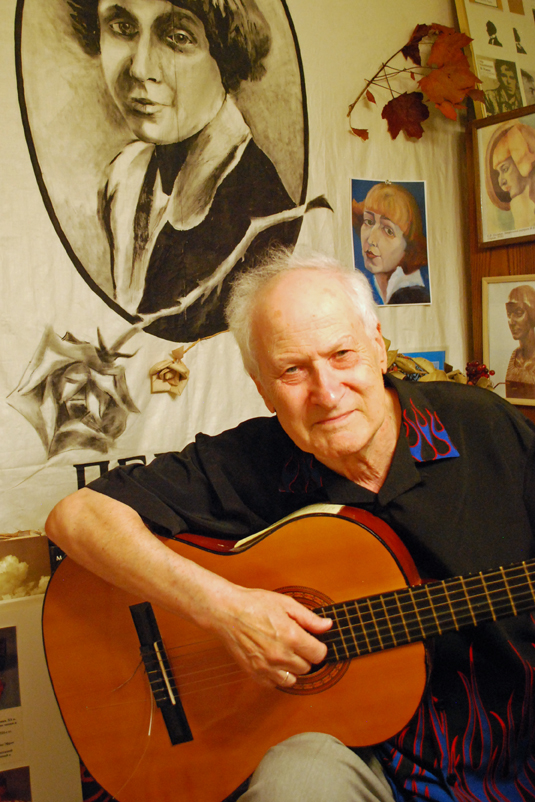
This month, I visited The Washington Museum of Russian Poetry and Music, which is currently housed in composer/performer/author Dr. Uli Zislin's home. Dr. Zislin is devoted to sharing Russian culture and he would dearly love to find another space for his museum -- one that people can visit more easily, without making an appointment! If anyone reads this who is also dedicated to sharing Russian culture and would like to help Dr. Zislin relocate the museum, email me or Dr. Z.

I thought I'd share works by poets spotlighted in the museum:

Boris Pasternak (1890-1960) is famous for writing the novel Doctor Zhivago, for which he won a Nobel (although the book was banned in the USSR). He wrote poetry as well:

February. Get ink, shed tears.
Write of it, sob your heart out, sing,
While torrential slush that roars
Burns in the blackness of the spring.
Go hire a buggy. For six grivnas,
Race through the noise of bells and wheels
To where the ink and all you grieving
Are muffled when the rain shower falls.
To where, like pears burnt black as charcoal,
A myriad rooks, plucked from the trees,
Fall down into the puddles, hurl
Dry sadness deep into the eyes.
Below, the wet black earth shows through,
With sudden cries the wind is pitted,
The more haphazard, the more true
The poetry that sobs its heart out.

~~~~~~~~~~~~~~~~~~~~~

The Muse
By Anna Akhmatova (1889-1966)
Translated by Eric Gillan

When late at night I wait for her arrival,
It seems my life is hanging by a thread.
I offer youth, my freedom, glory,
To my adored guest with flute in hand.
And here she comes. She throws back her cloak
And pours a steady gaze on me.
I ask, "Did you dictate to Dante
The pages of "Inferno?" She answers, "Yes. I did."

~~~~~~~~~~~~~~~~~~~~~

The Giraffe
by Nikolai Gumilev, (1886-1921)
Translated by Katharine Gilbert

Today, I see, your gaze is particularly forlorn,
And your hands particularly thin, embracing your knees.
Listen: far away, far away, on Lake Chad,
A refined giraffe is roaming.
His proportions are harmonious and his legs are long,
And a bewitching pattern adorns his skin;
Nothing dares compare with it, save the moon,
Fragmented and flowing on the liquid of broad lakes.
He juts out like the many-colored sails of ships,
And his gait is floating, like joyous birdflight.
I know this earth has seen many wonders
When at sunset he hides in a marble grotto.
I know the happy stories of secret lands,
About the dark maiden, about the passion of the young chief,
But you have breathed in the heavy mists for too long -
You will believe in nothing, except rain.
And how I would tell you about tropical orchards,
About elegant palms, about the scent of extraordinary grasses…
You're crying? Listen… far away, on Lake Chad,
A refined giraffe is roaming.

~~~~~~~~~~~~~~~~~~~~

To Byron
by Marina Tsvetaeva (1892-1941)
Translated by Ilya Shambat

I think about the morning of your glory,
About the morning of your days too, when
Like a demon you from sleep had stirred
And were a god for men.
I think of when your eyebrows came together
Over the burning torches of your eyes,
Of how the ancient blood's eternal lava
Rushed through your arteries.
I think of fingers - very long - inside
The wavy hair, about all
Eyes that did thirst for you in alleys
And in the dining-halls.
About the hearts too, which - you were too young then -
You did not have the time to read, too soon,
About the times, when solely in your honor
Arose and down went the moon.
I think about a hall in semi-darkness,
About the velvet, into lace inclined,
About the poems we would have told each other,
You - yours, I - mine.
I also think about the remaining
From your lips and your eyes handful of dust.
About all eyes, that are now in the graveyard
About them and us.

~~~~~~~~~~~~~~~~~~~~

What shall I do with this body they gave me
by Osip Mandelstam (1891-1938)

What shall I do with this body they gave me,
so much my own, so intimate with me?

For being alive, for the joy of calm breath,
tell me, who should I bless?

I am the flower, and the gardener as well,
and am not solitary, in earth’s cell.

My living warmth, exhaled, you can see,
on the clear glass of eternity.

A pattern set down,
until now, unknown.

Breath evaporates without trace,
but form no one can deface.
 
~~~~~~~~~~~~~~~~~~~~
Another poem by Pasternak: Winter Night

Saturday, July 28, 2012

Museum Exhibits

Few museum exhibits related to Ariadna Efron: interpreter, artist, poetess, writer, and the daughter of Marina Tsvetaeva and Sergei Efron.

Thursday, July 26, 2012

The 17th Tsvetaeva Bonfire in Washington, DC

The 17th Tsvetaeva Bonfire in Washington, DC will take place on October 7th 2012.
 
On October 8th 2012 (the 120th birthday of Marina Tsvetaeva) those who wish to honor the memory of the great Russian poetess are invited to lay flowers by Tsvetaeva's tree on the Alley of Russian Poets in DC in Guy Mason Park.

Monday, July 23, 2012

New translations of Russian Poet Marina Tsvetaeva by Ilya Shambat


Poets

1

Poet - from afar starts a speech.
Poet - for long leads the speech.

With planets, with signs, with roundabout
Tales's potholes... between yes and nay
He even having swung from the belfry
Took out the hook... For comets' way

Is poets' way.  The torn links of causation -
That's his connection! Forehead up - despair!
You know that the eclipses of the poets
Are not foretold by the calendar.

He's he, who mixes cards together,
Who does deceive all count and weight,
He's he, who asks from the school desk,
Who towers head and shoulders over Kant,

Who is just like a tree in its own beauty
Within the stone coffin of Bastille.
He is a train on which late are all comers,
Whose traces have been chilled
Always... For comets' way

Is poets' way: burning and not warming.
Tearing, not growing - to break up and tear -
Your pathway, o the mantled curved one,
Is not foretold by a calendar!

2

There are the extras, the unneeded
That do not fit within the norm.
(Not counting in your dictionaries
To them the landfill is their home).

There are the hollow, the pushed-down,
There are the mute - like dung,
Nail - to your silken skirt hem!
Dirt from under the wheels is wrung!

There are the unseen, the imaginary:
(Sign: speck of an autumn hen!)
There are the Jobs within the world
That would have envied Job - when:

We're poets - and in rhyme with scapegoats,
But from the shore thus having gone,
We argue over God with goddesses
And argue over girls with gods!

3

What should I do, blind and a stepson,
When all have fathers and have eyes,
When on anathema like embankments
Of passion! Where runny nose is the
Name of cry!

What should I do, with rib and thought
Singing! - like wire! Siberia! Sunburn!
Upon your dreams - like on the bridge!
With their weightlessness
In weights' world.

What should I do, singer and firstborn,
When gray is blackest in the world!
Where inspiration's like in thermos!
With this measurelessness in
Measures' world?!

Ilya Shambat
More translated poetry by Ilya Shambat can be found here.

Monday, July 9, 2012

Washington Museum of Russian Poetry and Music Today

Flags of the US and Russia.

Exposition of rarities, anthologies, literature on Alexander Pushkin. On the right side there are portraits of Akhmatova (on the top) and Tsvetaeva (lower).
 

Festival of Marina Tsvetaeva.

Section of Russian books in English and books by American and English writers in Russian.
 

Section of memorial photos and posters in two languages.

Booklets of literary museums of Russia.

Fragment of the children's section.

Literary archives of XVIII, XIX, and XX centuries.

Five greatest poets of the Silver Age.

Section of Russian Artists.

Museum section with music materials.
Pictures by Victoria Whitaker and Uli Zislin.

Tuesday, July 3, 2012

A Man Who Lives in the Museum: Dr. Uli Zislin Gifts Russian Culture to Rockville

Earlier announced article has finally been published!
Please see the original text on the Montgomery magazine web site, or read it below:

By Andrei Romanov | Photography by Victoria Whitaker

More often than not, the most peculiar places you discover provide the most memorable experiences. In a city that prides itself on its multicultural awareness, there is such a place. It’s an oasis of another culture, and one that has yet to be discovered by the local population.
The Washington Poetry & Music Museum, established in 1997, is also home to a man of passion and vision. Part of what Russian writer and poet Vladimir Nabokov termed “the wave of Russia gone out of its shores” that “spilled all over the world,” Dr. Uli Zislin brought with him as much of Russia as he possibly could. He simply couldn’t leave behind the books, photographs, paintings, recordings and personal items of his favorite poets that he had been collecting for years. This became the foundation for the only private museum of its kind in the country.
Hidden in Zislin’s modest rental apartment on Veirs Mill Road in Rockville, the museum is dedicated primarily to five of the great Russian poets of the late 19th- and early 20th-century Silver Age: Anna Akhmatova, Boris Pasternak, Osip Mandelstam, Marina Tsvetaeva and Nikolai Gumilev. Zislin’s priceless collection of their work and associated ephemera is a true feast for lovers of Russian culture and a cultural discovery for everyone else.
The Communist regime tried to stomp out the influence of the Silver Age by banning and censoring work, and these poets suffered tragically for their art. Osip Mandelstam was sentenced to a gulag and died at age 47 in 1938. Marina Tsvetaeva suffered through exile, isolation, the arrest of her husband, daughter and sister, and the execution of her husband; in 1941, she committed suicide at the age of 49. Nikolai Gumilev was executed in 1921 when he was 35. Anna Akhmatova, who had also been Gumilev’s wife, was subjected to continued repression by the Stalinist regime: Their son was expelled from the university and sentenced to 10 years in a gulag, and her work was condemned and censored for most of her life. Boris Pasternak, best known outside of Russia as the author of Doctor Zhivago, lived through a massive campaign against him by the Soviet State that hastened his death. Their manuscripts and books, documents and letters, photographs and paintings were confiscated and destroyed during searches.
Fortunately, the work of these persecuted poets was distributed and recited clandestinely among the intelligentsia and published abroad, most notably in the U.S. Zislin was among those few in the Soviet Union who knew and cherished their masterpieces. His lifelong interest in these masters and his sense of moral duty to them and the people deprived of an opportunity to enjoy their works became the driving force behind his U.S. museum.
Now in its 15th year, the museum has recently expanded to include materials related to the poets of the earlier, 19thcentury Golden Age, as well as famous Russian composers. Walls are lined with books, pictures and posters, and artifacts grace every table, shelf and stand. Highlights include rare book editions, manuscripts, autographs, biographies, letters, translations into many languages, portraits, photographs, audio recordings and video film. Visitors will be amazed to discover a two-volume 1891 edition of poems by Mikhail Lermontov; a bronze medal issued in 1899 in commemoration of Alexander Pushkin’s centennial birth anniversary; eyeglasses worn by Anastasia Tsvetaeva, a writer and sister of Marina Tsvetaeva; a sheet from the manuscript Amor, a novel Anastasia Tsvetaeva wrote in a gulag, and a pen she used to dedicate copies of her books.
Over the years, the museum has received many donations—so many that today, part of the collection is in storage. Zislin has no room for anything else. Really there is not much room for the man who lives in the museum. After a 2005 visit to the museum, a poet and descendant of the famous Russian poet Alexander Pushkin, who is also named Alexander Pushkin, wrote the following epigram:
Mesmerized by Uli’s passion,
Captivated by his zeal,
I am troubled by one question:
Where’s his room in this museum?

Cultivating Culture
Zislin’s passion extends beyond the walls of his private museum. To commemorate the Russian poets’ legacy and in recognition of the support they received in the U.S., Zislin founded the Alley of Russian Poets in D.C.’s Guy Mason Park. Started in April 2003 as a row of five trees dedicated to each of the museum’s Silver Age poets, the alley has grown to include trees dedicated to the poets of the Golden Age and includes a stone commemorating five Russian composers—Pyotr Tchaikovsky, Sergei Rachmaninov, Igor Stravinsky, Dmitri Shostakovich and Sergei Prokofiev.
Each year in October, Zislin organizes the Tsvetaeva Bonfires to continue the tradition of Tarusa, a Russian village, where sisters Marina and Anastasia Tsvetaeva spent their childhood summers. People gather to remember Marina, reciting her poems and adding their own tributes. James Foy, a retired professor from the Georgetown School of Medicine who is also a physician-poet, notes that last year’s “recitations by young students from the local Russian School were an important contribution, touching and from the heart.” Oct. 7, 2012 will mark the 17th Tsvetaeva Bonfire in Washington, D.C.
Seeing the level of interest that American visitors have for his museum and how little the general public knows about Russian culture, Zislin has decided to donate his collection to his home city of Rockville. He hopes it will become the foundation of a Museum of Russian Culture. “There exist museums dedicated to Russian music or Russian literature, but nowhere in the world is there a comprehensive Museum of Russian Culture,” says Zislin.
Foy remarks, “The world has recognized Russian music, drama, ballet and letters as an essential ingredient in education and entertainment. Uli is an ambitious emissary for the tradition and is determined to further its claims on our intellect and in our hearts.”

For more information or to schedule a time to visit the Washington Poetry & Music Museum, visit www.museum.zislin.com
This story was published in the July/August 2012 issue of Montgomery Magazine.