The purpose of this blog is to introduce the Museum of Russian Poetry and Music to the wide American audience and attract like-minded enthusiasts who wish to promote Russian culture in the US. Read more.

Monday, July 9, 2012

Washington Museum of Russian Poetry and Music Today

Flags of the US and Russia.

Exposition of rarities, anthologies, literature on Alexander Pushkin. On the right side there are portraits of Akhmatova (on the top) and Tsvetaeva (lower).
 

Festival of Marina Tsvetaeva.

Section of Russian books in English and books by American and English writers in Russian.
 

Section of memorial photos and posters in two languages.

Booklets of literary museums of Russia.

Fragment of the children's section.

Literary archives of XVIII, XIX, and XX centuries.

Five greatest poets of the Silver Age.

Section of Russian Artists.

Museum section with music materials.
Pictures by Victoria Whitaker and Uli Zislin.

Tuesday, July 3, 2012

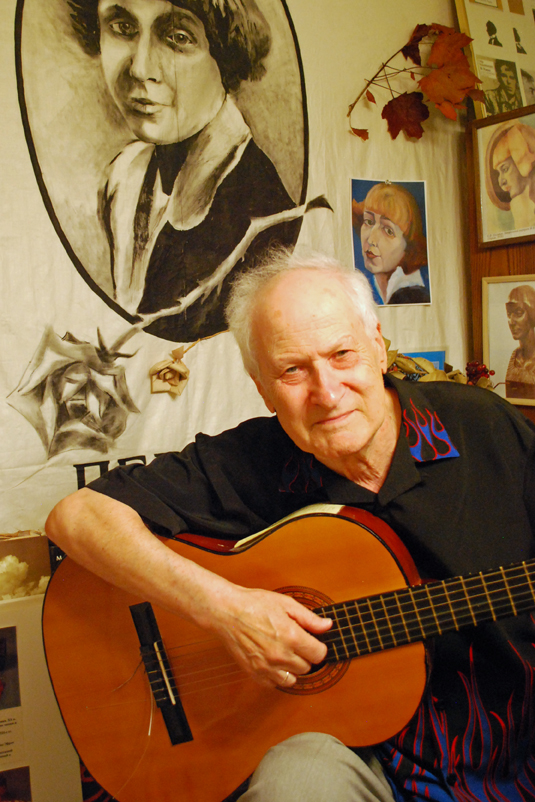
A Man Who Lives in the Museum: Dr. Uli Zislin Gifts Russian Culture to Rockville

Earlier announced article has finally been published!
Please see the original text on the Montgomery magazine web site, or read it below:

By Andrei Romanov | Photography by Victoria Whitaker

More often than not, the most peculiar places you discover provide the most memorable experiences. In a city that prides itself on its multicultural awareness, there is such a place. It’s an oasis of another culture, and one that has yet to be discovered by the local population.
The Washington Poetry & Music Museum, established in 1997, is also home to a man of passion and vision. Part of what Russian writer and poet Vladimir Nabokov termed “the wave of Russia gone out of its shores” that “spilled all over the world,” Dr. Uli Zislin brought with him as much of Russia as he possibly could. He simply couldn’t leave behind the books, photographs, paintings, recordings and personal items of his favorite poets that he had been collecting for years. This became the foundation for the only private museum of its kind in the country.
Hidden in Zislin’s modest rental apartment on Veirs Mill Road in Rockville, the museum is dedicated primarily to five of the great Russian poets of the late 19th- and early 20th-century Silver Age: Anna Akhmatova, Boris Pasternak, Osip Mandelstam, Marina Tsvetaeva and Nikolai Gumilev. Zislin’s priceless collection of their work and associated ephemera is a true feast for lovers of Russian culture and a cultural discovery for everyone else.
The Communist regime tried to stomp out the influence of the Silver Age by banning and censoring work, and these poets suffered tragically for their art. Osip Mandelstam was sentenced to a gulag and died at age 47 in 1938. Marina Tsvetaeva suffered through exile, isolation, the arrest of her husband, daughter and sister, and the execution of her husband; in 1941, she committed suicide at the age of 49. Nikolai Gumilev was executed in 1921 when he was 35. Anna Akhmatova, who had also been Gumilev’s wife, was subjected to continued repression by the Stalinist regime: Their son was expelled from the university and sentenced to 10 years in a gulag, and her work was condemned and censored for most of her life. Boris Pasternak, best known outside of Russia as the author of Doctor Zhivago, lived through a massive campaign against him by the Soviet State that hastened his death. Their manuscripts and books, documents and letters, photographs and paintings were confiscated and destroyed during searches.
Fortunately, the work of these persecuted poets was distributed and recited clandestinely among the intelligentsia and published abroad, most notably in the U.S. Zislin was among those few in the Soviet Union who knew and cherished their masterpieces. His lifelong interest in these masters and his sense of moral duty to them and the people deprived of an opportunity to enjoy their works became the driving force behind his U.S. museum.
Now in its 15th year, the museum has recently expanded to include materials related to the poets of the earlier, 19thcentury Golden Age, as well as famous Russian composers. Walls are lined with books, pictures and posters, and artifacts grace every table, shelf and stand. Highlights include rare book editions, manuscripts, autographs, biographies, letters, translations into many languages, portraits, photographs, audio recordings and video film. Visitors will be amazed to discover a two-volume 1891 edition of poems by Mikhail Lermontov; a bronze medal issued in 1899 in commemoration of Alexander Pushkin’s centennial birth anniversary; eyeglasses worn by Anastasia Tsvetaeva, a writer and sister of Marina Tsvetaeva; a sheet from the manuscript Amor, a novel Anastasia Tsvetaeva wrote in a gulag, and a pen she used to dedicate copies of her books.
Over the years, the museum has received many donations—so many that today, part of the collection is in storage. Zislin has no room for anything else. Really there is not much room for the man who lives in the museum. After a 2005 visit to the museum, a poet and descendant of the famous Russian poet Alexander Pushkin, who is also named Alexander Pushkin, wrote the following epigram:
Mesmerized by Uli’s passion,
Captivated by his zeal,
I am troubled by one question:
Where’s his room in this museum?

Cultivating Culture
Zislin’s passion extends beyond the walls of his private museum. To commemorate the Russian poets’ legacy and in recognition of the support they received in the U.S., Zislin founded the Alley of Russian Poets in D.C.’s Guy Mason Park. Started in April 2003 as a row of five trees dedicated to each of the museum’s Silver Age poets, the alley has grown to include trees dedicated to the poets of the Golden Age and includes a stone commemorating five Russian composers—Pyotr Tchaikovsky, Sergei Rachmaninov, Igor Stravinsky, Dmitri Shostakovich and Sergei Prokofiev.
Each year in October, Zislin organizes the Tsvetaeva Bonfires to continue the tradition of Tarusa, a Russian village, where sisters Marina and Anastasia Tsvetaeva spent their childhood summers. People gather to remember Marina, reciting her poems and adding their own tributes. James Foy, a retired professor from the Georgetown School of Medicine who is also a physician-poet, notes that last year’s “recitations by young students from the local Russian School were an important contribution, touching and from the heart.” Oct. 7, 2012 will mark the 17th Tsvetaeva Bonfire in Washington, D.C.
Seeing the level of interest that American visitors have for his museum and how little the general public knows about Russian culture, Zislin has decided to donate his collection to his home city of Rockville. He hopes it will become the foundation of a Museum of Russian Culture. “There exist museums dedicated to Russian music or Russian literature, but nowhere in the world is there a comprehensive Museum of Russian Culture,” says Zislin.
Foy remarks, “The world has recognized Russian music, drama, ballet and letters as an essential ingredient in education and entertainment. Uli is an ambitious emissary for the tradition and is determined to further its claims on our intellect and in our hearts.”

For more information or to schedule a time to visit the Washington Poetry & Music Museum, visit www.museum.zislin.com
This story was published in the July/August 2012 issue of Montgomery Magazine.


Monday, June 25, 2012

Museum projects in press

The article about the Washington Museum of Russian Poetry and Music will appear in the next issue of the «Montgomery» magazine. From this article the readers will learn about the museum project and other initiatives that are associated with it. Stay tuned! 


Saturday, June 23, 2012

About the Museum Founder

Uli Zislin was born in Moscow and came to the USA in 1996.
In 1997, he founded the museum in the Greater Washington area and opened it to visitors.
Mr. Zislin is:
• a poet and writer - three of his poetry books were published in 1992, 1996, and 2000, and two books of prose were published in 2008 and 2009;
• a collector (since 1978),
• songwriter (since 1949),
• song performer (in Russia, the US, France, Canada, Georgia, and Israel);
• an organizer and host of the first Moscow festival (1994-1995 season) and All-American festival (2002-2003 season) of the songs based on Marina Tsvetaeva’s poems;
• an initiator of the Alley of Russian Poets and Composers in Washington, DC, and Russian book collection in Rockville Memorial Library, MD;
• an author of more 200 publications in journals and newspapers in the USA, Russia, Ukraine, Georgia and Israel (since 1996).
• an author of the idea of creating «The American Museum of the full Russian Culture » for the American public at the large.

Thursday, June 21, 2012

Museum is seeking support

Museum is seeking support for expansion of an exciting project — American Museum of Russian Culture.
Originally based on private collections of an enthusiast, a poet and singer from Moscow Uli Zislin, this unique museum is already functional and growing. It contains versatile memorabilia, artifacts, audio and video materials, and rare documents dedicated to famous Russian poets and composers from Pushkin and Lermontov to Tsvetaeva and Mandelstam, from Tchaikovsky and Rachmaninoff to Prokofiev and Shostakovich, and additionally a collection of musical/literary records authored by the museum founder.
Augmented by many donations, the Museum exposition has been constantly growing. A tour of the Museum is free, by appointment (museum@zislin.com). The museum founder runs a program to introduce visitors to the collection and make them hear, feel, and watch shining glimpses of the Russian culture.
The Museum has already become famous, attracting visitors from across the US and many other countries. It has served a source of many initiatives including celebrations dedicated to Tsvetayeva’s anniversary in many US states and a few other countries, organization of a large Russian department in the Washington Public Library, foundation of a Memorial Alley and Meadow dedicated to famous Russian composers and poets, and more.
With more support and a formal affiliation, an American Museum of Russian Culture could serve an even wider audience, becoming a gateway to anyone who is interested in the treasures of the rich Russian cultural tradition, a true conductor of the Russian culture on the American Land.
Composition of the new Museum will be in English. The Museum will be offering series of thematic literary and musical performances, exhibitions, and film shows. The American Museum of Russian Culture will incorporate Russian literature, poetry, music, ballet, theater, movies, folk music, and art. This is very rare when a museum combines such different cultural aspects.
To share your thoughts, suggestions, or to arrange a museum visit, please contact the Museum founder Uli Zislin at museum@zislin.com or (301)942-2728.

Friday, June 15, 2012

The First Post

Coming in 1996 to Washington, the museum founder, Uli Zislin,  began to create a new world of Russian culture.Thus started the "washington Museum of Russian Poetry and Music," taking up three rooms of the apartment of Uli Michailovich, where he placed 30 collections. Having visited this museum in 2005, a direct descendant of Alexander Pushkin, New Your poet and literary worker 
Alexander A. Pushkin, wrote in his journal this epigram: 
"Passion carries Uli Zislin, 
Question taunts me all the time: 
The man lives in the museum 
Where does he himself reside?"

The museum opened in Autumn 1995 and was reconstructed in 2002 and 2011. It was visited by Russian culture affeccionades from 32 cities in 21 states of America and 35 cities of 15 nations of the world, including 15 Russian cities.

The museum conducted in America a series of large and small literary and musical performances (altogether over 400, including 25 on television and radio in New York,Washington, Baltimore and Boston).

There have been over 200 publications in USA, Russia, Israel and Ukraine about the work in the archives of the Museum, covering poets Marina Tsvetaeva, her sister Anastasia and son Georgi (Mura), along with Osip Mandelshtam, Boris Pasternak, Anna Akhmatova, Nikolai Gumilev, Ilya Ehrenburg, L. Ozerova, N. Rubtsova, Bulat Okhudzhava, Vladimir Vysotsky and Russian language in America (among them, more than 50 about Tsvetayeva). The museum has onmany occasions been mentioned in SMI of these countries (especially in American editions). The Washington museum has a widely visited website  (www.museum.zislin.com).

The most significant exhibitions in the museum regarding Tsvetaeva are as follows: 
- Genuine autographs of Ariandna Efron and Anastasia Tsvetayeva, 
- personal accounts by Anastasia Tsvetaeva and Michael Gertschenzon, 
- original portraits of Marina Tsvetaeva, Boris Pasternak, Osip Mandelshtam, Nikolai Gumilev, Anna Akhmatova, Anastasia Tsvetaeva, 
- a large collection of photographs;
- video recordings of conversations with Olga Truchaveva;
- video and audio recordings of Tsvetaeva evening in America;
- the vase "Red Ashberry" (work of Washington sculptor Lee Prayer);
- floor from the room of Marina Tsvetaeva on the Borisoglebsky Alley;
- 151 leaves of autographs of Marina Tsvetaeva from the Bachmet archive;
- copies of a graphic painting by Marina Tsvetaeva from the RGB archive;
- the first edition of Marina Tsvetaeva's prose in a separate book (New York, 1953, from the archive of E. Altshuller);
- an unpublished photo of Alexey Eisner;
- a recording by Valentina Tsvetkova of readions of Marina Tsvetaeva by Anastasia Tsvetayeva;
- a recording of a conversation by A.N. Brodelschikova, films of Tsvetaeava;
- and few more video and audio programs and recordings. 

The pride of the museum is a bronze medal from 1899, released in the memory of Pushkin's centennial, along with its gypsum copy, created in Lithuania in for 200th anniversary of the poet. It's not possible not to mention the Pushkin calendar from 1937, two books of the poems and the writings of descendant Alexander A. Pushkin, who lived in New York. Mikhail Lermontov is presented with an nonstandard graphic portrait and rare two-tome edition of his works in 1891 with illustrations by Vasnetsov, Korovin and of course Vrubel. Here the drawings are organized with an artistic depiction of the book by a professor of arts Leonid Pasternak to the poem "On the death of the poet" and play "Masquerade." In the museum there is also a catalog of the exhibition of work by L. Pasternak, which was given to the Moscow museum of Leo Tolstoy and etc.

The museum is an imitation to cultural events in USA. For example, the Tsvetaeva bonfires (there have been 16 of these bonfire-literary readings in nature) and the Tsvetaeva song festivals (2003-2004), the Russian public library (existing for more than five years), the alleys of Russian poets and composers (existing for around 10 years), the chamber concerts of Russian music and performances by Russian musicians, etc. In the museum was conceived the idea of conducting Tsvetaeva bonfires, beginning in 2002, creating a multi-pronged museum of Russian culture for the broader American public (in 2011 there is an application for its creation around Rockville, a suburb of Washington).

One of the principles, concerning the Washington museum of literature and music, which in 2012 turns 15, is making the visitors familiar with other museums and private collections dedicated to the great Russian poets. In the Washington museum are presented, along with Marina Tsvetaeva and her family, the poetical museums of Alexander Pushkin, Michail Lermontov, Anna Akhmatova, Alexander Blok, Maximillian Voloshin, Nikolai Nekrasov, Sergei Klytchkov, Sergei Yesenin, Nikolai Rubtsov, Yevgeniy Yevtushenko, Alexey Koltsov.